
a matryoshka of possibilities
a matryoshka of possibilities
down the rabbit hole we go...

“Be slightly wary of the whole endeavor. Describe things. Look for interesting trapdoors. Make matryoshkas of meaning. Enjoy good digressions. Say how you feel, and keep going.”
In my previous essay I asked the question “How do I write a good essay in a single sitting?” I was very happy with the answer, even though it’s incomplete, because it surprised me, and gave me a new insight– that beyond the courage it takes to start and to keep going, it also takes courage to establish good information architecture– or really any good arrangement of things. Still, I find myself wanting to probe further into the original question. I didn’t particularly go deep into “what do I consider to be a good essay?”, because a part of me feels like my answer would be nebulous and vague, and another part of me worries that even trying to articulate the answer would be a futile act, like trying to map an infinitely complex territory. That part of me is a little paranoid, and warns, “Beware!! If you make any sort of map at all, there’s a chance you’ll end up mistaking it for the territory!” Which… isn’t wrong. But I pause to ponder. Does that mean then it’s better to operate without any map whatsoever? Sometimes that can be true, but currently I feel like I can be trusted to attempt some mapmaking, and I can trust my readers to understand where I’m going with this.1 So, a new question: what’s the bare minimum I need to do to write a good essay? In other words, what’s the shortest good essay I can write?
Immediately I feel obliged to caveat that my definition of a good essay is something deeply personal to me, and not at all a claim about essays in general. There are surely all manner of ways to write good essays that I can’t even begin to imagine. In fact, as I just said a little differently, I worry that if I describe a particular kind of good essay, my description of it might then crowd out other possible definitions that I haven’t considered. And yet, if I never describe what a good essay is, I feel like I’d be fumbling in the dark for a long time. So here are some vague pencil sketches.
For me, in my own writing, a good essay is something liberating, something expansive. Something that makes me see things differently. Something surprising. I’ve come to realize that I don’t like writing essays where I know in advance exactly what every sentence is going to be. No, it’s more than that. I don’t like writing essays where I’ve already made up my mind about what I’m going to say, and then I’m simply arguing my case. Sometimes I’ve felt the impulse to do that, usually when I witness somebody else getting something wrong, but when I am free to do whatever I please, such as right now, my desire is to dance at the edge of my understanding.
I had a mental image in the shower recently of a particular style of essay that I’m conceptualizing. I begin by describing something, which in my mind I imagine to be a room. I might describe the objects in the room, and what it might be for. But then, if I do it just right, something about the description of that room reveals a trapdoor. And my task is to open that trapdoor and fall through it. Now we’re in a different room. Perhaps we’ve been here before, but it’s less familiar. We have less of an intuitive sense of this space. It may contain some surprises and intrigue. And perhaps that’s enough. But ideally, I think there’s at least one more trapdoor in this new room, which takes us to an even more alien domain, one of which we may have almost no intellectual familiarity or understanding whatsoever, and yet in a surprising way, it seems to me that as we go deeper into the unknown, we find ourselves closer to universal qualities, associated with myth.
“The unconscious sends all sorts of vapors, odd beings, terrors, and deluding images up into the mind—whether in dream, broad daylight, or insanity; for the human kingdom, beneath the floor of the comparatively neat little dwelling that we call our consciousness, goes down into unsuspected Aladdin caves. There not only jewels but also dangerous jinn abide: the inconvenient or resisted psychological powers that we have not thought or dared to integrate into our lives.” — Joseph Campbell, The Hero With A Thousand Faces (1949)
You could think of this series of trapdoors as “stories within stories”, or even “dreams within dreams” – in some ways I just described the structure of the movie Inception (2010).
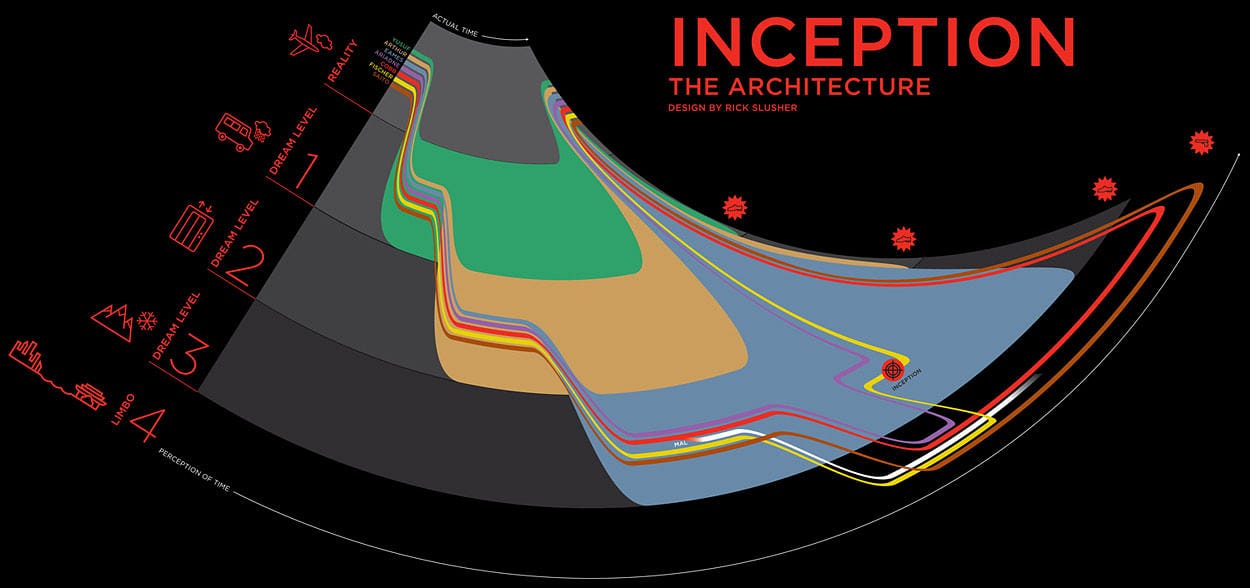
But I think I’m pointing at something ancient and universal, harkening back to Odysseus and the Mahabharata and Sinbad: frame stories. I’ve been meaning for a long time to write an essay about frame stories, provisionally titled My Debt To Scheherazade, the narrator of One Thousand and One Nights, but I have not yet been able to get it just right. I feel like one ought to use a frame story to talk about frame stories, which requires a dexterity I do not yet possess. So I’ll simply mention the idea of it in passing, and perhaps revisit it in the future. The main thing I wanted to say about Scheherazade, whom I do love dearly with all my heart even if she doesn’t “technically exist” (she’s real to me the same way Santa Claus is), is that she taught me that storytelling can save your life. I’ve carried that lesson with me always. We are always telling stories, whether we realize it or not. We might as well get good at it. Good stories win people over. They provoke and inspire and inflame the human spirit. It’s a tremendous source of power. Stories are Trojan horses of meaning. For reasons that might be easier to demonstrate than to explain, I’d like my essays to be Matryoshkas of meaning.

There’s another essay that I’ve been meaning to write that also feels relevant here, likely titled Artful Incompleteness. The idea is simple: we are finite beings living amidst infinite complexity, anything we make is going to be invariably incomplete. (I’m vaguely recalling a quote from somewhere arguing poetically that only God would be capable of telling the full story of everything, which would necessarily take all of Time.) So the challenge for us mortals is, can we make something incomplete that is beautiful rather than lacking? Something where the fragments imply a greater whole? Or phrased another way, can anybody make anything as beautiful as a cloud or a tree? Maybe not perfectly, but I think when we look around us, we can see that people have accomplished something approximating this well-enough before. You could argue that this is mainly a quirk of the limits of human perception, but I’d say that’s good enough for me. If I can “fool” someone into thinking I’ve made something basically as beautiful as a tree, that would be a profound and meaningful accomplishment. We don’t need an infinite set of elements in order to convey a sense of infinity to a reader or viewer. We can “just” imply it. However, just as I’ve found it daunting to try and do justice to the concept of frame stories, I’ve found it tough to create a perfectly imperfect wabi-sabi essay about incompleteness. I do giggle at the thought; there’s an obvious insoluble paradox to it, but I’m not quite ready to give up on the idea just yet. I do think it’s possible that one day I’ll write the perfect imperfect essay, probably by trying to do something else. Or maybe I’ll just live a good life as an author with an empty spot in my corpus where that essay “should” be, and laugh about it to myself as an inside joke. “I never completed that essay about artful incompleteness,” I see myself telling my grandkids at my deathbed. “Lol,” I say. “Lmao.”
I also wanted to talk about scrubs. Scrubs are a concept from video games. I remember it as a sort of bottom-up emergent idea, but David Sirlin has written what can probably be considered the canonical definition of the term, which is that “A scrub is a player who is handicapped by self-imposed rules that the game knows nothing about.” A scrub yells “no fair!” or “that’s cheap!” when someone wins a game by playing it in a way that he considers inferior, for example by “overusing” a particular move. You can see how people can be scrubs in all sorts of domains. Most recently I’ve encountered people whining that Taylor Swift “doesn’t deserve” to sell out stadiums and make a billion dollars doing what she does, because “she’s not even the best singer or songwriter”. The assumption there is that the most technically skilled singer “should win”, which is, of course, not at all how the world works. Scrubs are not interested in understanding how the world works. They’re interested in their model of reality, and in grumbling and arguing with people about how their model is superior. This could be viewed as an is-ought complication, which John Nerst wrote an interesting post about, full of examples such as “taxation is slavery”. Pulling on these threads can get you to some really abstract philosophical territory, but I think the practical questions are things like… do you think you can persuade people to choose to give their money to the most technically skilled singer on the planet, whoever they are, rather than Taylor Swift? If you think yes, and that that’s a worthwhile thing to do, then… good luck, I guess. I think it’s much more interesting to ask why Taylor is so popular, which gets us to all sorts of interesting insights about what people want from an artist, what people are willing to pay for, and so on. Useful insights that are applicable beyond their immediate context.
The reason I bring up scrubs as a concept is because feel compelled to confess that I am one, or I have been one, when it comes to essay-writing and creative work. In my defense I’d like to plead that I’m at least not the worst kind of scrub; I don’t impose my views on other people. I’m a private scrub with regards to my own work. In the tavern and the temple I talk about wanting to be the Greater Fool, who believes that it’s worthwhile to do work that is meaningful, that goes beyond what people expect. Isn’t that kinda scrubby…?
Well… having written this out, I think there’s some nuance here that I wasn’t grasping before I started. After all, there’s two parts to being a scrub, one is being averse to anything that feels cheap or wrong, and two is that they lose. Video games are a comparatively finite domain (in the Carsean finite-and-infinite games sense). There are clear winners and losers. And your aversion to using a particular set of moves in that narrow context is almost definitely going to cost you. Writing essays, on the other hand, is much more of an infinite game– you might write a good essay here or there, but really the move is to keep playing. Over the course of a lifetime, one might choose to be “scrubby” as an essayist by avoiding anything that feels cheap, and nonetheless still go on to win quite remarkably at games of one’s choosing.2
However, simplistic notions of winning and losing aside, I do feel that there is a truth to the idea that, in my writing, I flinch too much from things that I vaguely perceive as bad, cheap, wrong, etc. I think this is a mistake. It feels like an outdated behavior pattern that probably fulfilled a particular purpose in the past– protecting me when I was less experienced and less discerning– but it no longer feels relevant. It’s due for an update.
Re: over-flinching, I suspect I likely make this mistake outside of writing, too. One of the most interesting things about practicing any kind of creative art is noticing how the particular mistakes I make tend to stem from deeper personal issues that I have going on.
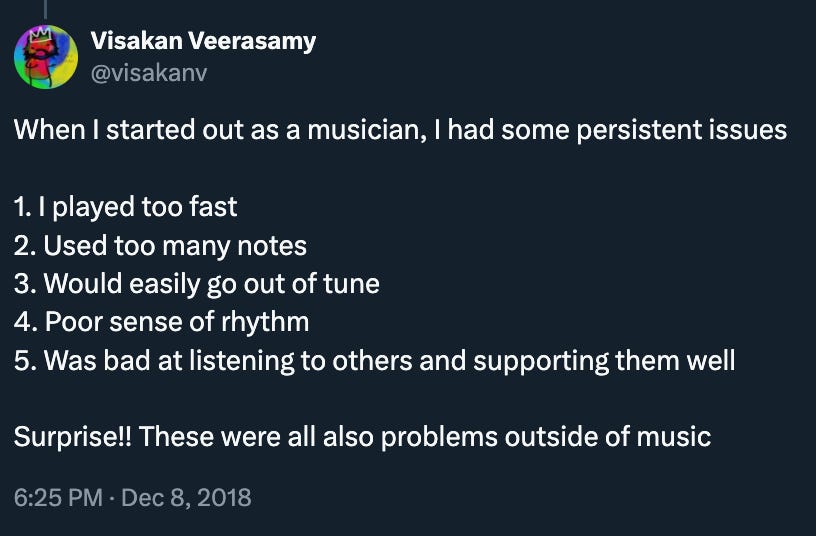
It’s probably correct to say that I’ve learned more about myself from examining the creative works I’ve made over the years, than from trying to observe myself directly. Because direct self-observation does tend to have all manner of observer effects, which can really get in the way of self-knowledge. (Although upon reread I also find myself thinking that there are also really valuable modes of “self-observation” that aren’t quite “self-observation” in the sense of subjecting oneself to inquiry and analysis. I might describe those modes as things like “attunement”. Language is so tricky because you can never know with certainty what connotations people have when they read a word or phrase. I think there are subtle differences in the quality of attention that people bring to themselves that make a world of difference. If you subject yourself to something like a hostile interrogation, that likely won’t go the way you want. It’s complicated. To really get into it is a long, drawn-out process. And yet I do think it’s a very worthwhile one, which is why I wrote a whole book titled Introspect. And why… I’m about to continue observing myself, haha. It’s not really a contradiction. It actually rhymes again with what I was saying about maps and territories. All self-observation is self-cartography. All maps are wrong, but some are useful. Caveat emptor.)
Anyway, let’s get back to examining that outdated behavior pattern of flinching, and the desired update. What am I flinching from? There’s an example right at the beginning of the essay: “What’s the bare minimum I need to do to write a good essay?” I flinch from that question because I worry that simply asking that question might nudge me towards becoming a ‘bad person’. Once I say that out loud, I can laugh at it, and I can experience some real relief. And this is the thing I am always hoping to get to with my essays!! I’m always looking for some of the relief that comes from simply describing things, observing them as non-judgementally as I can manage, and insodoing, noticing things that were previously obscured from my perception by my cached assumptions. I write to brush off the thick dust of familiarity. Any time I accomplish that, I’ve written a good essay, even if the majority of the essay is “meaningless meandering”! Wow!
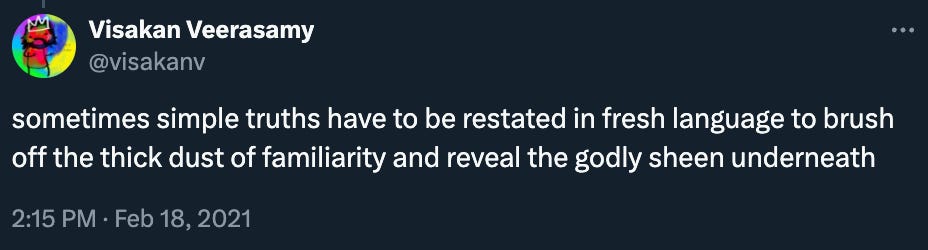
It’s funny, I haven’t even gotten around to actually really diving into the question and I feel so good already. I suppose it’s like finding out that “it doesn’t really matter”, although intellectually I can tell that it will have interesting potential repercussions and consequences. Knowing how to do something well with less effort is a valuable bit of information. How to apply that knowledge well is maybe even more important. (I’m stalling again!) Visa, cut the shit– what is the minimum you need to do to write a good essay? What constitutes a good essay? Let’s recap what I’ve talked about so far. “Be slightly wary of the whole endeavor. Describe things. Look for interesting trapdoors3. Matryoshkas of meaning. Enjoy good digressions. Say how you feel, and keep going. Brush off the dust of familiarity.”
Alright, some clues here. A good essay should be interesting, or compelling, or surprising. I believe I’ve written about this in a previous substack essay, interestingness on demand. The question I have is, what did I not have in that essay? How come that essay didn’t solve all my problems? Let me scan it and do a quick overview: It’s my job to be interesting… it’s cool but also kinda stressful… i gotta try hard but not too hard… i often come up with good ideas in the middle of other ideas… if i feel like i’m not trying hard enough, i’m probaby misframing the problem…
Hm. I was really close. Everything seems basically correct, but I think when I wrote “I often come up with good ideas in the middle of other ideas”, I was thinking “so I should ditch the old idea for the better one”, rather than “I should birth the better idea out of the ‘lesser’ one”. I basically had noticed where the good stuff was coming from, but I hadn’t yet quite developed a sensibility for how I wanted to present it, how I wanted to do the information architecture. And I think it took some amount of courage for me to say, “Yes, I’ll leave in the wrong turns and mistaken ideas,” like I did earlier when I called myself a scrub.
I do still want to talk about the scrub thing and my thoughts around incompleteness. Here’s a screenshot of an artist drawing the same picture of Spider-Man 3 times, giving himself 3 different lengths of time to work on it:
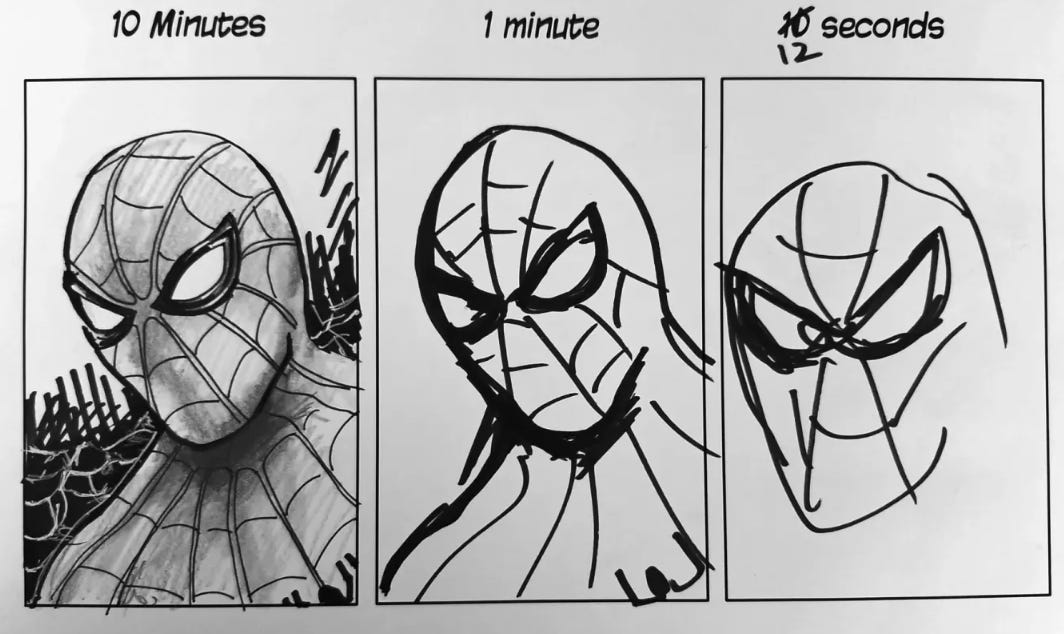
I recommend clicking through the link above to watch the timelapse, it’s quite entertaining. In the first, he has the time to be really careful and measured, getting all the lines nicely right, and then doing the shading. In the second, he has to be in a rush, and doesn’t quite manage to do all the lines. Yet it’s still quite recognizably Spider-Man. The third is especially funny to watch, and arguably it is also recognizably Spider-Man, and you could even say it has more goofy personality that either of the other two drawings.
Now, I feel a version of this when working on my essays. The timescales are longer. There are some essays I feel like I could easily spend an entire year working on, getting all the lines and shading and proportions right. But the idea of taking that long is daunting to me, especially given my life circumstances where I have a wife and 5-month-old child to care for. And I have to ask myself, what if I just made my essays like the second or (gasp) third images? What if I spent way less time on them? The first thing I worry about is, will my readers understand that that’s what I’m doing? It seems that it’s important to my ego that my readers know that I am capable of doing elaborate shading and carefully portioned lines and so on. I just don’t have that kind of time. This again brings us back to Stupid Bravery and the courage required to make and arrange things. I can see the big picture long view for my work, but most of my casual readers won’t. They’ll just see an essay that was okay but not great; it was kinda tedious and meandering really. And this is a thing I have to learn to accept, in order to eventually do my best work. My best work isn’t going to be a single panel of well-shaded Spider-Man, my best work requires the gestalt of many characters, many ideas, many things. That means I’ll have to do imperfect sketches and simply trust that it’ll all make sense eventually. It’ll get more elegant in the future once I have my stuff out, receiving responses and feedback and so on. I do believe it.
I want to try again to answer the original question. What is the bare minimum I need to do to write a good essay? I need to describe the things that I’m seeing, thinking, feeling. I need to lay it all out around me and feel for resonance. And then I need to test and examine that resonance from multiple angles. I need to ask questions and try to answer them. But here’s the part that I think is what I really wanted to get to: for me to write a good essay for myself, I have to consider and contextualize it within my wider body of work. A good essay for me is no longer something that’s spectacular or shiny. A good essay can be a bunch of muck that helps me get unstuck. A good essay is something that challenges and inspires me to write the next one. In that regard, each essay is a matryoshka that births the next.
Nassim Taleb’s ideas around antifragility are particularly relevant here – it’s difficult if not impossible to accurately predict things like “when will this outcome happen in this complex ecosystem”, but it can sometimes be predicted that some outcome would happen eventually, and that can be very useful.
Funny, this is the second time I’ve noticed that I was taking a concept better suited to sports, and misapplying it to the arts. Previously I used to describe my notebooks as “full of false starts”– I’ve since found it far healthier to describe them as “full of sketches and studies”, which is a more accurate description, and far less upsetting.
Upon rereading, I realize that the trapdoor metaphor is a reinvention or remix of Lewis Carroll’s rabbit-hole. But hey, I love reinventing wheels, and I especially love replacing stale metaphors with fresh ones. Thick dust of familiarity and all that.
"when I am free to do whatever I please, such as right now, my desire is to dance at the edge of my understanding." - stunning metaphor, along with the trapdoors.
I completely relate to this definition of what makes a "good essay" for ME. Meaning, what yields a positive experience, based on the process of creation itself. I can feel the difference in my body when writing for authentic internal growth and expansion, vs. external validation. The former feels liberating, the latter suffocating.
This resonates a lot. I'm definitely a version of a scrub when it comes to leveraging social tools to connect with my audience. I choose to do things I know are detrimental (or not do things I know will help expand my reach) because I tend to put my ideals before everything else. For instance, I know that Substack has a ton of dark patterns due to which, I stopped using it for 7 months. Of course that hurt my subscriber growth. However, I decided to move back when I realized that nobody cares about my ideals and I'm the only loser in this race (and I'd hate to become someone who criticizes Taylor Swift just because I don't get her and because my musical taste continues to go back in time.
Also, I've had my fair share of struggles when it comes to choosing between quality and quantity. I've always prioritized the former and have refused to publish when I'm not happy with my work. I have refused to publish just for the sake of consistency. However, even though focusing on quality and optimizing for resonance helped me stand out and gain attention in my early days of publishing online, it hasn't served me very well in recent times. And now, even though I don't intend to compromise on quality, I am working towards a system to produce more work that is good enough rather than aiming to make everything of the best.
I particularly like the way you describe what a good essay is for you, "A good essay for me is no longer something that’s spectacular or shiny. A good essay can be a bunch of muck that helps me get unstuck. A good essay is something that challenges and inspires me to write the next one." This also reminded me of one of your videos I watched recently where you say that one should try and make a lot of stuff. And this is a timely essay on this exact topic by someone whose work I admire a lot: https://jayacunzo.com/blog/quantity-or-quality-answer-something-else
Thanks again for writing this!