how we fall apart
it's hard to stay in the goldilocks zone

I ended the last post by saying that I’ll write next about how and why great organizations don’t seem to endure. I think the question also applies more broadly to scenes, or the understanding of human flourishing that animates those organizations and scenes. They all seem fleeting and fragile. Why? It feels like a question that I could spend years answering. I’m going to write about it for about an hour.
There’s a meme that I’m known for online, typically called “Visa’s dominos meme”. I didn’t invent the underlying format, but I used the format in a particular way to talk about how good things might lead to better things:


It’s really resonated with people, and some people have credited it for inspiring them to pursue something, or have incorporated it into their own visions or remixed it in some way. What not many people know is that this was actually a response to an earlier version I made 10 minutes earlier, where I describe how bad things lead to worse things.


And there’s a clue to the answer: simplistically speaking, good things perish because they’re overtaken by bad things. The natural question that arises next is: why?
More examples and ideas are coming to mind now:
i. Enforcing boundaries and standards is a challenging thing to do appropriately. The “goldilocks zone” is narrow. People tend to go too hard or not hard enough, and both have costs. If you go too hard, you create a hostile culture that increasingly spends more time and energy policing people’s behavior (see “wrongful or weaponized implementation in anti-abuse system” above). This drives away good people who aren’t interested in participating in that, and it discourages those who remain. On the other hand, if you don’t enforce boundaries and standards, then bad actors (whether malicious or ignorant– doesn’t actually matter) will end up crowding out the commons, which also drives away good people. This can be described as an evaporative-cooling effect (Xianhang Zhang, 2010), or death-via-pacifism (Eliezer Yudkowsky, 2009).
So how do you enforce boundaries and standards appropriately? And how do you disseminate that understanding skillfully? That’s the trillion-dollar question, and I don’t have an easy answer. But I’ll try to approach and approximate it repeatedly over the course of posting on this Substack. If you’d like to dive into more readings, I have accumulated a list that I often share with friends who are thinking about starting or organizing communities here: visakanv.com/blog/communities
ii. Established organizations are bad at listening. I’m reminded of a Steve Jobs quote1 describing how salespeople rise up the ranks in organizations, largely because they seem to be responsible for generating the most revenue. But then they eventually crowd out the product people who actually had the sensitivity and know-how to make good products in the first place.
I think when I really reflected on this, I eventually relinquished the fantasy of maybe figuring out how to make the perfect organization. I realized that it would require a relentless battle against human nature, and the logistics and economics of that battle don’t quite make sense. It makes more sense to simply allow organizations to rise and fall, to grow old and die, or become quietly obsolete. To quote Steve again, death is life’s change agent: it clears out the old to make way for the new. What already happens makes more sense: dissatisfied agents within an existing organization make a break for it and start a fresh organization, unencumbered by all the baggage and scar tissue of the old. Fairchild Semiconductors was started by defectors from Shockley Semiconductors. Pixar relied on defectors from Lucasfilms’ computer graphics division. Dreamworks was founded by a Disney defector. Someone could probably write an entire book about all the defection that happens in video game studios. And one could even say the USA was founded by people defecting from the British Empire.
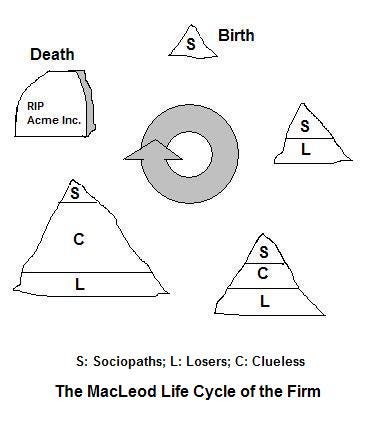
To be a bit dramatic about it– I feel that if you consider yourself loyal ‘to the realm’, to the world, to humanity– then it shouldn’t really matter to you that any particular organization persists. What matters is the animating spirit, the quality of aliveness in each organization, the skills, the knowhow, etc. And over the decades I’ve come to believe that there are thoughts and ideas and so on that simply cannot flourish in some particular environment that’s oriented in some particular way. Eric Yuan, the founder of Zoom, was previously a founding engineer at WebEx, which was acquired by Cisco, and he repeatedly tried to convince Cisco to update WebEx, but senior management wouldn’t listen. And so he left to start Zoom, taking dozens of engineers with him who agreed with his assessment of the situation.
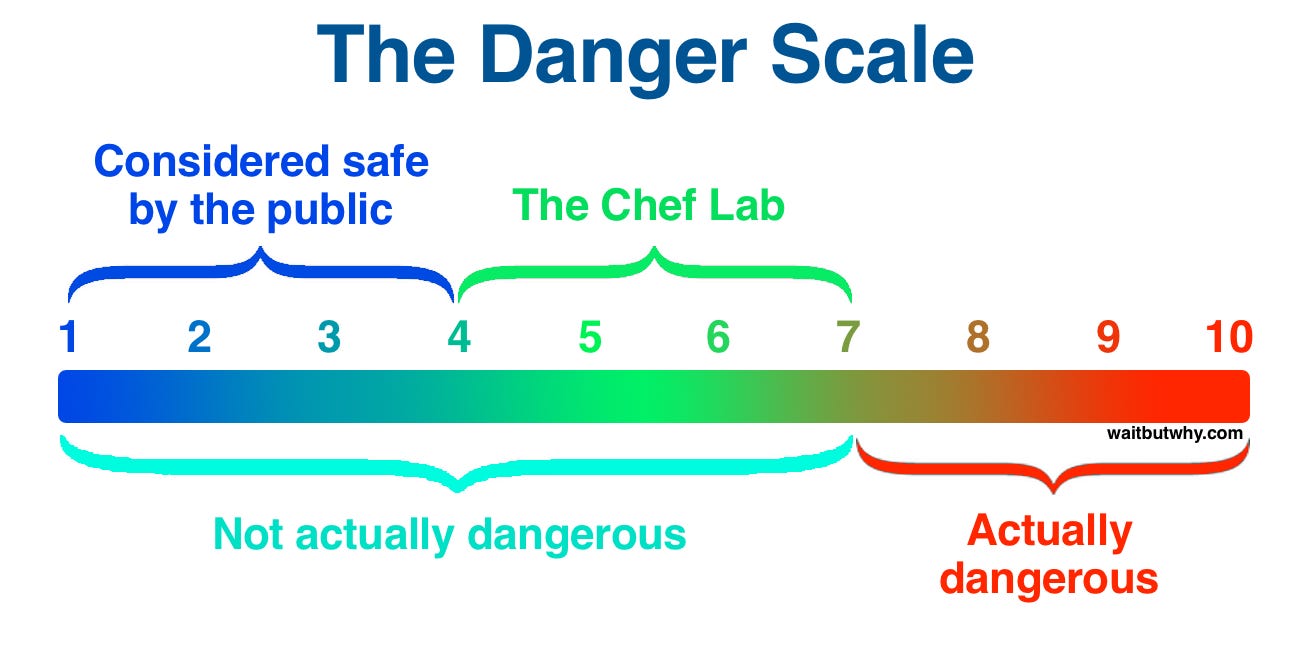
iii. it’s hard to stay long in the healthy danger zone. This is kind of a remix of point i. I’m reminded of the excellent WaitButWhy post The Cook and the Chef (2015), which describes what i’ll call the “healthy danger zone”, which is where all the good stuff in life happens. And this is an uncomfortable place to be. You’re going to have to push yourself beyond what you’re comfortable with. You’re going to be challenged for it socially, which most people can’t really take too much of.
I’m also reminded of how Miles Davis’s bandmates described working with him. They said things like “we were like scientists experimenting live on-stage every night trying to do semi-controlled explosions”. Which was what made the shows so compelling! And Miles would recruit unknown young talents from everywhere– he didn’t care about anything except whether or not they could play, and he would challenge them to play better than they’d ever played. When they expressed worries that the public might not like their experimentation, he said “I’ll handle the public, you just play.” Miles strikes me as an exceptional person that’s hard to define simply, because he’s full of contrasts– ambitious, hard-nosed, yet also in some senses tender. He was fierce in protecting creative space, but he was also cryptic, and would fire people for not meeting his expectations. Most people probably wouldn’t enjoy working for Miles Davis, but those that did were incredibly loyal to him. I think that’s a recurring thing you’ll hear about leaders who achieved great things, which doesn’t necessarily mean that they’re good people.

I’m basically talking about the Goldilocks zone again, and the point I’m trying to make is that it’s very difficult to keep people in the Goldilocks zone. It’s especially hard to keep many people in the Goldilocks zone, for a long period of time, especially if there are big rewards like money and fame and sex etc that come into play. It’s been a while since I read Masters of Doom (2003) – great book about the origin story of the video game Doom (1993). What I do remember thinking as I read it was: John Romero and John Carmack seemed to have fruitful conflicts in the early days. Carmack was the talented hacker who figured out how to expand the possibility-space of what game engines could do, and Romero had great instincts for how to give gamers the visceral action experience they wanted. Initially they relied on each other and kept each other in check, and were able to accomplish much more together than either of them could have accomplished on their own. But once Doom made them wealthy and famous, they no longer really needed to have a good working relationship, and things kinda fell apart.
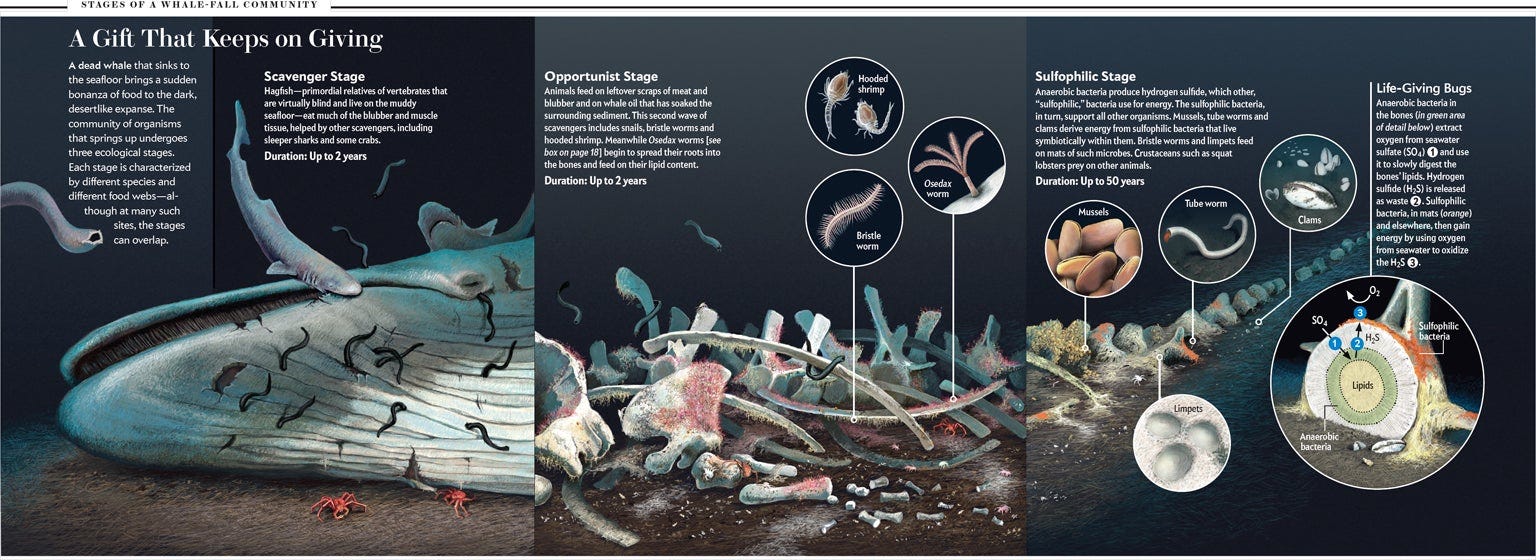
It’s just very difficult for human beings to manage the challenges of making anything successful. And over the years I’ve come to think that we probably should learn to accept that things fall apart.2 Sure, we can try and slow the collapse of things by introducing healthy norms around conflict and communication and so on. But beyond that, I think it makes more sense to think about wider ecologies: how do we make sure that the deaths of organizations or scenes (which are ways of organizing people and things) don’t mean that all the constituent elements must die too? How can things be recycled better? How can knowledge be preserved? I think about that sort of thing a lot and have much more to say about that, but in closing this post I’ll just say that I like thinking about whale falls: “On the sea floor, these carcasses can create complex localized ecosystems that supply sustenance to deep-sea organisms for decades.”
Here’s the full quote, from the documentary Triumph of the Nerds (1996):
“It turns out the same thing can happen in technology companies that get monopolies, like IBM or Xerox. If you were a product person at IBM or Xerox, so you make a better copier or computer. So what? When you have monopoly market share, the company’s not any more successful.
So the people that can make the company more successful are sales and marketing people, and they end up running the companies. And the product people get driven out of the decision making forums, and the companies forget what it means to make great products. The product sensibility and the product genius that brought them to that monopolistic position gets rotted out by people running these companies that have no conception of a good product versus a bad product.
They have no conception of the craftsmanship that’s required to take a good idea and turn it into a good product. And they really have no feeling in their hearts, usually, about wanting to really help the customers.”
I also want to include this quote via Asimov’s Foundation: “The fall of Empire, gentlemen, is a massive thing, however, and not easily fought. It is dictated by a rising bureaucracy, a receding initiative, a freezing of caste, a damming of curiosity, a hundred other factors.” […] “I do not say now that we can prevent the fall. But it is not yet too late the shorten the interregnum which will follow.”


just to say, you constraining yourself timewise has been v cool, these 100 day posts are some of your best (substack work)
I've been working a lot on my fitness this year and I've noticed that sustainable progressive overload is basically tracking a moving goldilocks zone that shifts as my capabilities improve. Do you think there's some version of progressive overload that can be applied to group/organization/scene settings? Or is it impractical?